


Below the Surface: A Closer Look at the South Prosser Creek Watershed and the Euer Valley Restoration Project
Association News, Forestry, Member News, TrailsBy Cynthia Cendreda
Turn of the Century Industries Impacting Today’s Ecosystem Health
The hallmark of Tahoe Donner’s trail system year-round remains Euer Valley, with its breathtaking fields of wildflowers, lush marshes, historic structures dating back to the turn of the century and most stunning of all, the South Fork of Prosser Creek winding through. Providing critical habitat for local flora and fauna – including black bears, mule deer, marmots, red-tailed hawks, osprey and more – the creek’s health remains a critical component of the valley’s delicate ecosystem.
Once the ancestral territory of the Washoe Tribe, they spent their summers in the Truckee-Tahoe basins, hunting, fishing and gathering plants, nuts and other natural resources for food, medicine and other utilitarian purposes. Living in harmony with their surroundings, the Washoe Tribe’s subsistence lifestyle existed for centuries, allowing the basins’ ecosystems to replenish their flora and fauna season after season.
In all its stunning surface beauty, it’s easy to imagine the once idyllic existence of the Washoe subsisting on the pristine bounty of Euer Valley – a meandering creek, fields of wild grasses and flowers, towering pines on either side and evidence of creatures great and small at every turn. But a closer look reveals critical human impacts over the last century that have accelerated South Prosser Creek’s decline, drastically changed the landscape and jeopardized the valley’s long-term sustainability.

With 200 acres purchased in 2003 and an additional 482 acres purchased in 2011, the Tahoe Donner Association long endeavored to be a dutiful steward of the Euer Valley. Foundational to its recreational programming and a cherished part of its natural resources, the association included the valley’s long-term restoration in its 2012 Trails and Master Plan and welcomed guidance on balancing its recreational use with its protection and preservation. Nearly a decade later, in 2022, in collaboration with the Truckee River Watershed Council (TRWC), a Prosser Creek Watershed Assessment was completed. The comprehensive report, which detailed the physical and biological attributes of the Prosser Creek watershed and basin, its history and the challenges and opportunities for restoration and enhancement, served as the catalyst for the multi-phased Euer Valley Restoration Project.
Understanding Watershed Dynamics in Euer Valley
A watershed, or drainage basin, is an area of land in which all flowing surface water converges to a single point, such as a river mouth or into another body of water like a lake or ocean. The Prosser Creek Watershed with the South Fork of the Prosser Creek flowing through to the Truckee River, encompasses the Euer Valley. Recent studies have highlighted the impacts of legacy land use, including logging and dairy and cattle operations, which continue to influence the watershed’s hydrology to this day, as well as opportunities to mitigate the ongoing effects of the association’s recreational activities.
Following the gold rush and Comstock Lode silver rush of 1859, miners set their sights on new enterprises in logging to expand the Central Pacific Railroad, the nation’s first transcontinental railroad, over Donner Summit. Among these industrialists were the Euer Family, who leased their land for logging and owned a sawmill as late as 1908. A narrow-gauge railroad was created to accommodate loggers on the southside of Euer Valley and and the Euer Sawmill. As timber harvesting fell out of practice due to deforestation, more and more loggers, including the Euers, turned to ranching and dairy farming, with cattle operations continuing in the valley as late as the early 2000s.
Such rigorous human activities drastically changed the landscape, and consequently, the water flow into and out of the creek. According to Tahoe Donner’s director of Land Management + Open Space, John Groom, “soil compaction and vegetation loss from intensive logging at the turn of the century, and salvage logging associated with more recent events similar to the 1960 Donner Ridge Fire, have impacted the watershed’s hydrology, resulting in fast-flowing runoff during snow melt. This runoff also deposits loose sand, soil and other particles into the creek.”
This hydrologic dynamic creates a cascade of negative impacts on the watershed, from stream incision – accelerated erosion of the stream banks due to high-velocity creek effluence – to murky, turbid water from sedimentary deposits that can stifle sensitive aquatic habitats. Additionally, when too much water leaves a creek or riverbed and cannot be replenished, soil conditions change, affecting the adjacent riparian zones. Vegetation changes, including to wetland flora, and events like “conifer creep,” threaten the entire ecosystem. Unmitigated, such water and habitat loss could result in a barren valley.
A Collaborative Partnership + Multi-Phased Approach to Restoration
With a long-standing partnership spanning two decades, Tahoe Donner sought TRWC’s habitat restoration and grant-funding expertise to help determine the scope, budget and funding capacity for such a comprehensive land management undertaking. The overall cost for the first phase of the project was estimated at $3,014,348, including significant construction, road and trail repair or rerouting, revegetation of riparian zones and other streambank erosion mitigation.
To demonstrate its commitment to stewardship and ensure the success of large-scale grant funding from various agencies, the association invested $475,000 from the Replacement Reserve Fund. Remarkably, TRWC secured the remaining $2,539,348 from agencies including the Wildlife Conservation Board, State Water Board and the Sierra Meadows Partnership. According to Eben Swain, Project Director for Truckee River Watershed Council, the grants effectively transformed every dollar of Tahoe Donner’s investment into $7 in capital.
Phase 1
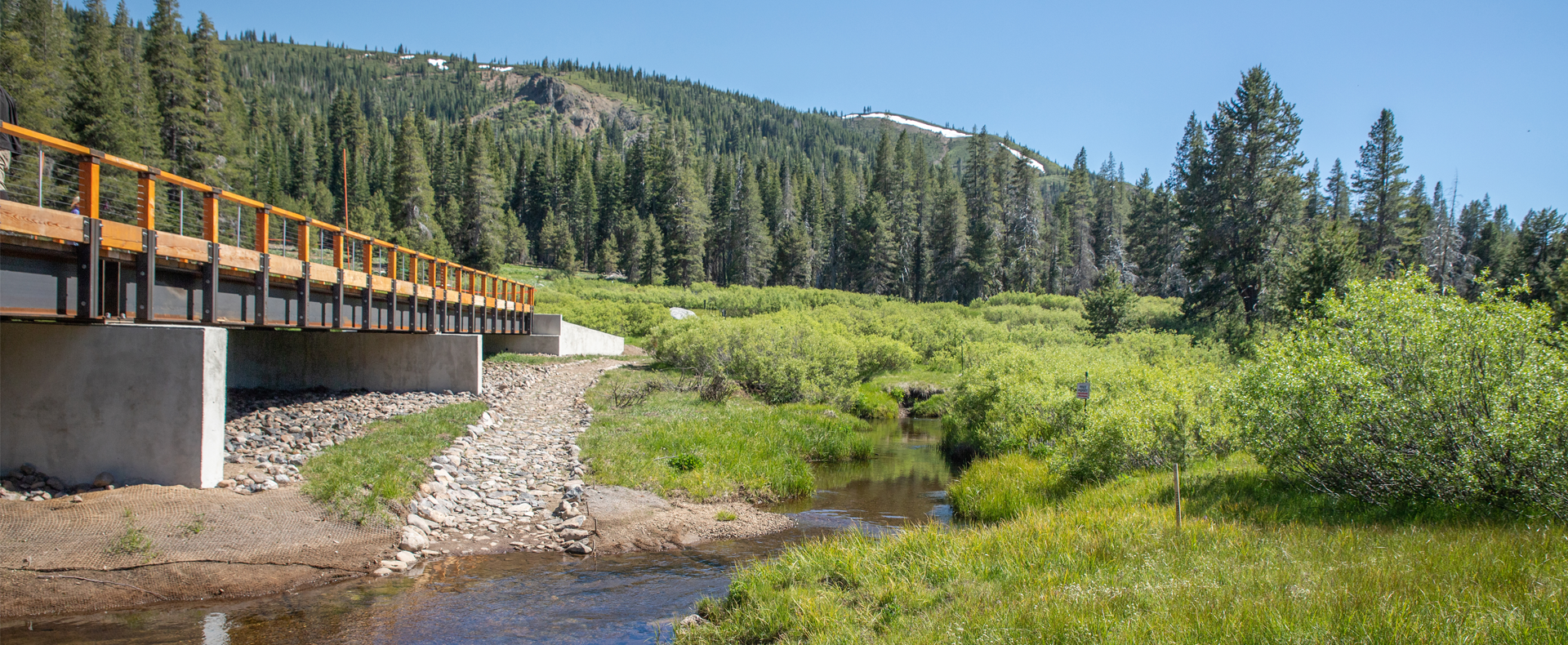
Now complete, the resource-intensive Phase 1 established the long-term restoration of a 30-acre high-quality meadow habitat in the valley. This included the implementation of a 512-foot boardwalk built on helical piers to relieve foot traffic on damaged trails and preserve sensitive wetlands across the meadow in the summer months, and provide a more sustainable roadway for trail groomers for the Cross Country Ski Center in the winter. A 150-foot bridge was also built over South Prosser Creek to replace a failing culvert and allow water to flow more naturally as it did prior to human impacts.
The elevated boardwalk and bridge allow trail users to fully immerse themselves in the meadow’s beauty. With thoughtfully designed vistas, visitors can enjoy a more bird’s-eye perspective of the expanse of wild grasses, shrubs and South Prosser Creek without disturbing the habitat restoration in progress.
Phase 2
Taking place now and continuing for as long as conditions allow into the fall, Phase 2 will focus on creek restoration along a half-mile section of South Prosser Creek to improve habitat for fish and other wildlife, as well as improving drainage along a one-mile stretch of degraded roadway, including along Alder Creek Road, Euer Valley’s main crossing, Crabtree Road, South Euer Valley Road and Broken Spoke. Creek restoration activities may include resurrecting environmentally compatible retaining walls to stabilize stream banks or direct water flow, or re-establishing native plants in riparian zones.
Long-term, the association will continue to monitor the valley’s health through water quality testing, studies and other measures.
Synergistic Stewardship
The Euer Valley Restoration Project is a multi-year, multi-phased endeavor that exemplifies the power of collaboration when values align. At the intersection of private land ownership and environmental accountability, the Truckee River Watershed Council remains a critical partner in Tahoe Donner’s ability to advance sustainable land management initiatives while balancing fiscal responsibility and enhancing the recreational experience.
According to Tahoe Donner General Manager Annie Rosenfeld, TRWC’s proven ability to secure grant funding is a testament to their commitment to protecting the environment and their ecological expertise, and it enables them to continue their important work with Tahoe Donner. Swain adds that he has “never experienced as many funders on a single project as he has with The Euer Valley Restoration Project,” attributing it to Tahoe Donner’s reciprocal willingness to invest in skilled forestry and land management staff, studies and other necessary resources to make the partnership a critically important one for sustaining the long-term health of the South Prosser Creek Watershed.
That both the association and TRWC share a profound obligation to protect and preserve the Truckee Tahoe basin’s natural resources is the foundation for a successful partnership in sustainable land management. To learn more about TWRC’s work in Euer Valley in collaboration with Tahoe Donner, visit their website.