


Zen and the Art of Grooming
Association News, Cross Country Ski Area, Downhill Ski AreaAn Inquiry Into the Substance of Snow
By Cynthia Cendreda
“To live only for some future goal is shallow. It’s the sides of the mountain that sustain life, not the top.” – Robert M. Pursig, Zen and the Art of Motorcycle Maintenance
Snow sliders, including every kind of skier and snowboarder, know better than most how to live in the present moment, navigating in real time, and at warp speed, every slope, chute, cornice, bowl, cliff, pillow, jump, hit, bank, berm, half-pipe, quarter-pipe, or other skiable surface on the side of a mountain. Sure, there’s some planning, some necessary preparation, but there’s also some risk of the unknown as you’re ascending (if you’re a Nordic Skier) or descending (for all you downhill enthusiasts), and perhaps that’s the allure, the rush.
But what of the reverse? The mountain operations teams that chase the perfect conditions to mold and shape snow into an epically carveable surface, with endless swaths of that distinct corduroy texture. A veritable ASMR (Autonomous Sensory Meridian Response) for your sensory ski brain, there is nothing quite like laying down turns on a chalky groomer on a cold morning to warm up your legs. To that end, ski groomers are the true masters of winter.

SIERRA CEMENT: SNOW PROBLEM
“Steel [or snow] can be any shape you want if you are skilled enough, and any shape but the one you want if you are not.” – Robert M. Pursig, Zen and the Art of Motorcycle Maintenance
Through some combination of science, snowcats and skills, groomers possess a unique ability to transform even the most elusive topography into thrilling black diamond runs, gentle beginner slopes, rolling cross country trails or even an awe-inspiring terrain park. And to understand this level of artistry is to acknowledge the precision required to sculpt Mother Nature’s frosted flurries into silky skiable ribbons, amid a host of unpredictable and unabating snow and weather conditions.
Very few art mediums present in as intensely varying volumes and consistencies as snow. High Sierra winters are often marked by feast-or-famine-type Pacific storm cycles, where precipitation is most reasonably measured in feet, not inches. Warmer coastal storms also impart higher moisture content with less evaporation than in places like Utah, where storms are generated inland and across multiple ranges, resulting in drier, lighter “champagne powder.”
So how does that impact grooming? According to “The Science of Ski Grooming,” an article written by Alisha McDarris for Popular Science Magazine, the more snow, the more havoc it wreaks on the machinery. In the article, Brian Dubuque, snow surface manager at Snowbasin, one of Utah’s top resorts, asserts that the best-case scenario is a light storm that drops between 2 and 4 inches of fresh, dry snow. Referring to it as “hero snow,” it’s easy and efficient to groom and creates a beautiful surface to ski on. With just six inches or more, snowcats can start sliding on steeper slopes as the tracks get packed with snow and lose traction.
Heavy, wet snow, which Dubuque refers to as mashed potato, or “Sierra Cement,” as Tahoe locals call it, creates another set of unique challenges. This type of dense snow can bind up in the machinery’s tiller and leave streaks in the corduroy. “It’s more challenging for groomers and requires—even more than usual—that they constantly adjust tiller speed and depth to create a good skiing surface…It’s not just set it and forget it; you’re always fiddling with something,” Dubuque explains.
STEEP HILLS ARE NO PLACE FOR CHEAP THRILLS
“Gumption is the psychic gasoline that keeps the whole thing going. If you haven’t got it, there’s no way the motorcycle can possibly be fixed [or the steep run groomed].” – Robert M. Pursig, Zen and the Art of Motorcycle Maintenance
While downhill enthusiasts may relish speed on steep runs, when it comes to grooming, slow and steady wins the race. Negotiating such precipitous pitches in a 20,000-lb machine, while contending with darkness, snow and weather conditions, is a methodical process not for the faint of heart.
On advanced and expert terrain, winch cats, specialized snowcats equipped with a heavy-duty winch system and a spool of up to 1,500 feet of high-tension, braided steel cable, are anchored securely to a fixed point at the top of the hill. Beginning at the bottom of the run, winch cats “pull” themselves back to the top, with the winch-assist allowing it to maintain traction and control as it grooms upward. Due to the high risk associated with the high-tension cables, even when slack, this type of grooming is only performed at night and on closed runs. It is important that skiers and snowboarders avoid any areas where winch grooming is being conducted.
So, when you’re carving down an immaculately groomed blue square or black diamond run free of yesterday’s moguls, don’t forget to raise an après pint to the mountain operations teams who labored into the wee hours while you were dreaming of fresh tracks and lodge snacks.
CORDUROY: BETWEEN THE LINES
“The way to see what looks good and understand the reasons it looks good, and to be at one with this goodness as the work proceeds, is to cultivate an inner quietness, a peace of mind so that goodness can shine through.” – Robert M. Pursig, Zen and the Art of Motorcycle Maintenance
Corduroy isn’t just an aesthetically pleasing and sensory texture; it plays a vital role in both the evaporation of moisture from the snow and in creating a more stable surface for turning or gliding on skis and snowboards. According to Yellowstone Track Systems, distributor of Ginzugroomers, rollers, tracksetters and other grooming equipment, the peaks and troughs indicative of corduroy–or corrugation, as it’s referred to for cross country ski, snowshoe and snowmobile trails–create minute pressure differentials. These differences promote the movement of moisture up through the snowpack to the tips of the peaks, where evaporation is accelerated by increased exposure to cold air. Corduroy also increases the surface area of the slope or trail, exposing more snow to the air, where moisture transfer occurs.
Snow metamorphism is the continuous change in its crystal structure, size and shape after falling, driven by temperatures, temperature gradients and moisture, leading to either stronger, rounded grains or weaker, faceted grains that significantly affect snowpack stability. Another phenomenon, known as “mechanical age hardening,” refers to the formation of ice bonds between snow grains, which increases the snow’s overall density and hardness. Grooming snow into corduroy facilitates both processes to stabilize the snow, while the triangular shape of the individual ridges adds strength and stiffness. Under ideal conditions, these corrugations can form a thin glaze or ice cap. Collectively, these caps can easily support the weight of a downhill or XC skier, snowboarder or snowshoer, with no impact to the ground beneath, resulting in a safer and more navigable surface, as well as a resilient and long-lasting trail or run.
Man + Machine
“Each machine has its own unique personality, which probably could be defined as the intuitive sum total of everything you know and feel about it. This personality constantly changes, usually for the worse, but sometimes surprisingly for the better, and it is this personality that is the real object of motorcycle maintenance [or snow grooming].” – Robert M. Pursig, Zen and the Art of Motorcycle Maintenance
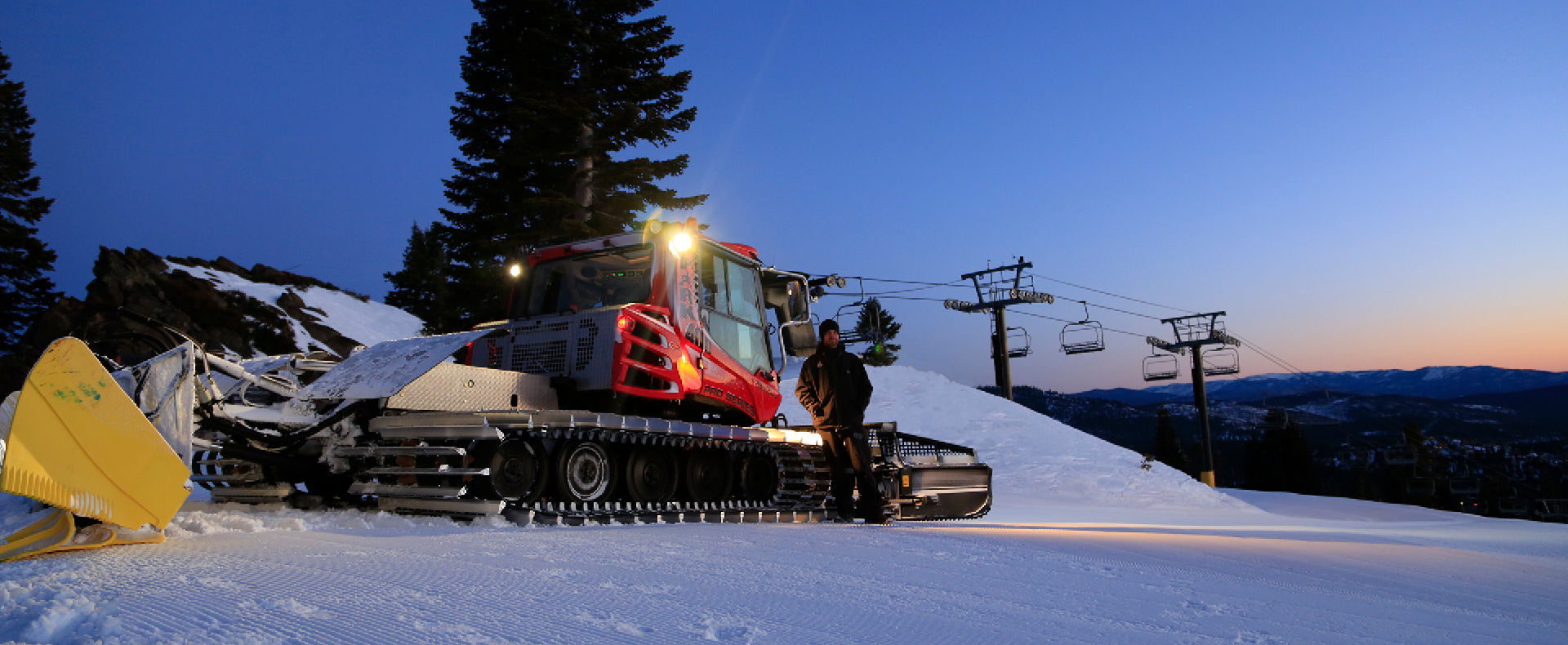
While the groomers at Downhill Ski Resort and Tahoe Donner Cross Country Ski Center possess in their own right a wealth of experience and expertise in sculpting and manicuring the slopes and trails, this 2025/26 season, their arsenal of heavy-duty tools has been enhanced with a brand-new PistonBully 400, a compact but features-loaded snowcat that boasts outstanding maneuverability, the cleanest exhaust technology, intuitive operability, a comfortable ride and SnowSAT technology.
To the extent that the new machine operates under the direction of the exceedingly skilled mountain operations teams, grooming at Tahoe Donner, whether on the high-elevation slopes at Downhill Ski Resort, or the winding trails of the expansive TDXC trail system, is likely to become an even more efficient process. Assisted by the SnowSAT snow depth sensing technology, operators can identify in real time how and where to utilize snow, saving time, fuel and energy, while creating the most stable trails and runs.
But ultimately, what is at the heart of grooming, whether using a state-of-art machine, or a track setter pulled behind a snowmobile, is, as Robert M. Pursig so often alluded to in Zen and the Art of Motorcycle Maintenance, a quality of care, a mindful and engaged approach to life and work that bridges the gap between man and machine and creates meaning in mechanical tasks, eventually leading to true craftsmanship and artistry.